
Thursday, October 30, 2008

Wednesday, October 29, 2008

Sunday, October 19, 2008
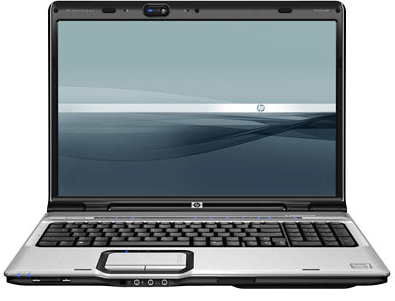
Acer Extensa 7620Z
This cheap laptop is a 17-inch model, which makes it relatively unique at
this price point. It may have a large screen, but the resolution is a
relatively ...
<http://www.techradar.com/products/computing/laptops-portable-pcs/laptops/acer-extensa-7620z-469748/review>
this price point. It may have a large screen, but the resolution is a
relatively ...
<http://www.techradar.com/products/computing/laptops-portable-pcs/laptops/acer-extensa-7620z-469748/review>
Monday, October 13, 2008
Apple Prepare for Laptop's Most Light
Even for comments on this launch cheap laptop, Apple also reluctant
respond. Fortunately, Van Baker, an analyst from Gartner, to give a little
input on the price range, this Apple notebook, which is approximately USD
799 to USD 999, ...
<http://theblackchocobos.blogspot.com/2008/10/apple-prepare-for-laptops-most-light.html>
respond. Fortunately, Van Baker, an analyst from Gartner, to give a little
input on the price range, this Apple notebook, which is approximately USD
799 to USD 999, ...
<http://theblackchocobos.blogspot.com/2008/10/apple-prepare-for-laptops-most-light.html>
Saturday, October 11, 2008
Acer Aspire 7520-5115
Super Sale on refurbished laptops notebooks. Save $100.00 today on most
refurbished laptop computers. With the innovative Acer Gemstone chassis,
the Aspire 7520 is designed for multimedia enthusiasts. Powerful AMD Turion
64 X2 Dual-Core ...
<http://blog.usanotebook.com/2008/10/acer-aspire-7520-5115-laptop-with-big.html>
refurbished laptop computers. With the innovative Acer Gemstone chassis,
the Aspire 7520 is designed for multimedia enthusiasts. Powerful AMD Turion
64 X2 Dual-Core ...
<http://blog.usanotebook.com/2008/10/acer-aspire-7520-5115-laptop-with-big.html>
Monday, October 6, 2008
Credit Card Affects Credit History
Cancelling a credit card can affect the credit history. When it comes to
your credit score, debt earlier is better than new debt. That is because
companies want to loan you have a long history of good debt management. ...
<http://www.moorfields.org/credit-card-affects-credit-history/>
Thursday, October 2, 2008
Cooling Your Hard Drive
For several different reasons, storage is a very important part of a computer. These days, computers do far more than they ever have in the past. From businesses to family photo’s, storage is the ideal way to keep documents on your computer. The most popular method of storage is the hard disk drive, which we all count on for keeping our data safe.
Even though the hard drive stores data, it isn’t perfect by any means. Hard drive failure is very common with all computers, with no real way to prevent it. Although there are several different reasons why a hard drive can fail, the most common is overheating. Viruses and crashes are common as well, along with theft and accidental deletion.
With the older style and mechanics of hard drives, the RPM speed was low, meaning that the drives wouldn’t overheat. The hard drives we use now days, have speeds between 7,200 and 10,000 RPM, meaning that they can get quite hot when they start working. Computers of this day and age come with fans to cool everything down, with most hard drives including temperature sensors as well, so you can keep track of just how hot your hard drive becomes.
With hard drives today, overheating is a very common problem. The faster hard drives come with speeds of 10,000 RPM, which can make the temperature soar above 70 degrees F, really heating things up inside the drive. The mechanics on the inside are built to withstand the heat, although if things become too hot, you’ll encounter problems. If a drive becomes too hot and ends up losing the data, it may be next to impossible to retrieve the information - no matter how good your data recovery specialists may be.
One area that suffers from the drive overheating is the platters, which are magnetic media. Platters are what carry the data throughout the hard drive. Platters are constructed from optical glass, aluminum, or ceramic and normally coated with a layer of magnetic material. Once the hard drive begins to heat up, the platters will start to expand, which changes their size. When this happens, the magnetic surface on the platters will get destroyed, which results in a loss of data. If the physical area of the platters are damaged, it will result in unreadable sectors.
Other areas of the hard drive that can be damaged due to overheating are the read and write heads, head actuator, and the controller chip. Hard drives are very sophisticated pieces of hardware, and can’t handle overheating. The read and write heads are a common example, as they can easily render the drive useless if they become damaged. If they get too hot, they don’t make any contact with media, which pretty much stops the flow of transfer from information to the computer.
To prevent your hard drive from overheating, you should always make sure that it is cooled properly and well ventilated. You can always get additional fans and coolers, which will improve both ventilation and the flow of air in your computer. You can buy fans and coolers at very affordable prices, which makes them an ideal investment for keeping your hard drive or hard drives cool.
You can also get software that monitors the temperature of your hard drive as well. Whether it’s software, or additional fans, you should always ensure that your hard drives are kept cool. By keeping them cool, you’ll greatly reduce the amount of crashes. You’ll also increase the stability of your hard drive as well, which will make your entire computer perform much better.
Even though the hard drive stores data, it isn’t perfect by any means. Hard drive failure is very common with all computers, with no real way to prevent it. Although there are several different reasons why a hard drive can fail, the most common is overheating. Viruses and crashes are common as well, along with theft and accidental deletion.
With the older style and mechanics of hard drives, the RPM speed was low, meaning that the drives wouldn’t overheat. The hard drives we use now days, have speeds between 7,200 and 10,000 RPM, meaning that they can get quite hot when they start working. Computers of this day and age come with fans to cool everything down, with most hard drives including temperature sensors as well, so you can keep track of just how hot your hard drive becomes.
With hard drives today, overheating is a very common problem. The faster hard drives come with speeds of 10,000 RPM, which can make the temperature soar above 70 degrees F, really heating things up inside the drive. The mechanics on the inside are built to withstand the heat, although if things become too hot, you’ll encounter problems. If a drive becomes too hot and ends up losing the data, it may be next to impossible to retrieve the information - no matter how good your data recovery specialists may be.
One area that suffers from the drive overheating is the platters, which are magnetic media. Platters are what carry the data throughout the hard drive. Platters are constructed from optical glass, aluminum, or ceramic and normally coated with a layer of magnetic material. Once the hard drive begins to heat up, the platters will start to expand, which changes their size. When this happens, the magnetic surface on the platters will get destroyed, which results in a loss of data. If the physical area of the platters are damaged, it will result in unreadable sectors.
Other areas of the hard drive that can be damaged due to overheating are the read and write heads, head actuator, and the controller chip. Hard drives are very sophisticated pieces of hardware, and can’t handle overheating. The read and write heads are a common example, as they can easily render the drive useless if they become damaged. If they get too hot, they don’t make any contact with media, which pretty much stops the flow of transfer from information to the computer.
To prevent your hard drive from overheating, you should always make sure that it is cooled properly and well ventilated. You can always get additional fans and coolers, which will improve both ventilation and the flow of air in your computer. You can buy fans and coolers at very affordable prices, which makes them an ideal investment for keeping your hard drive or hard drives cool.
You can also get software that monitors the temperature of your hard drive as well. Whether it’s software, or additional fans, you should always ensure that your hard drives are kept cool. By keeping them cool, you’ll greatly reduce the amount of crashes. You’ll also increase the stability of your hard drive as well, which will make your entire computer perform much better.
Buying a Cheap Laptop
Laptops are getting popularity over the personal computers among the up
coming generation. The foremost advantage of laptop is that you can access
to your desired information at any anywhere. You can carry your laptop
easily on working ...
<http://www.arcaromediagroup.com/217/how-to-buy-a-cheap-laptop/>
Are spyware items infecting your computer?
I just had, by mistake, a plug-in called Intelligent Explorer attach to my browser. What a nightmare! I have another article on this topic, but this brings home a point. Spyware or adware items are continually infecting computers. Most computers have no protection from them. Most frightening is the frequency of them. From the InfosecWriters web site, "According to a 2004 survey by America Online and the National Cyber Security Alliance, 91% of users questioned were familiar with the term spyware. Only 53% believed their computers were infected, but a scan found that 80% of their PCs had some type of spyware installed on them." It goes on to say, "...The average number of spyware components per computer was 93 with one computer having well over a thousand."
What is Spyware?
Butte College (www.bctv.butte.edu/support/spyware.html) offers this definition:
“The term ‘spyware’ is broadly defined as any program that gets into your computer without permission and hides in the background while it makes unwanted changes to your user experience.
Spyware is generally not designed to damage your computer. The damage it does is more a by-product of its main mission, which is to serve you targeted advertisements or make your browser display certain sites or search results.
At present, most spyware targets only the Windows operating system (Internet Explorer).”
To be fair, spyware can be harmless, for example tracking cookies don’t do much. While such things infringe on your privacy, they don't really harm anything. Others, however, are extremely dangerous.
So what do you do about it?
No spyware program seems to do everything, but there are a lot of goods solutions out there that can help. Here is a list of some of the top Spyware tools to look at:
1) Try Ad-Aware 6.0 Professional from LavaSoft (there is also a free version with less functionality)
2) Spybot Search & Destroy from PepiMK Software
3) Xoftspy form Pareto Logic
5) Spyware Guard from Javacool Software is a free program
4) Pest Patrol (now part of Computer Associates by acquisition)
5) McAfee Anti-Spyware
One thing is for certain: you do need to take spyware seriously. For some reason, too many people out there think anti-virus solutions are the end-all solution. They are not.
And, when all else fails?
Finally, as drastic as it seems, if your computer has been infected with a large number of spyware programs, the only solution you may have is backing up your data, and performing a complete reinstall of the operating system.
What is Spyware?
Butte College (www.bctv.butte.edu/support/spyware.html) offers this definition:
“The term ‘spyware’ is broadly defined as any program that gets into your computer without permission and hides in the background while it makes unwanted changes to your user experience.
Spyware is generally not designed to damage your computer. The damage it does is more a by-product of its main mission, which is to serve you targeted advertisements or make your browser display certain sites or search results.
At present, most spyware targets only the Windows operating system (Internet Explorer).”
To be fair, spyware can be harmless, for example tracking cookies don’t do much. While such things infringe on your privacy, they don't really harm anything. Others, however, are extremely dangerous.
So what do you do about it?
No spyware program seems to do everything, but there are a lot of goods solutions out there that can help. Here is a list of some of the top Spyware tools to look at:
1) Try Ad-Aware 6.0 Professional from LavaSoft (there is also a free version with less functionality)
2) Spybot Search & Destroy from PepiMK Software
3) Xoftspy form Pareto Logic
5) Spyware Guard from Javacool Software is a free program
4) Pest Patrol (now part of Computer Associates by acquisition)
5) McAfee Anti-Spyware
One thing is for certain: you do need to take spyware seriously. For some reason, too many people out there think anti-virus solutions are the end-all solution. They are not.
And, when all else fails?
Finally, as drastic as it seems, if your computer has been infected with a large number of spyware programs, the only solution you may have is backing up your data, and performing a complete reinstall of the operating system.
Subscribe to:
Posts (Atom)